
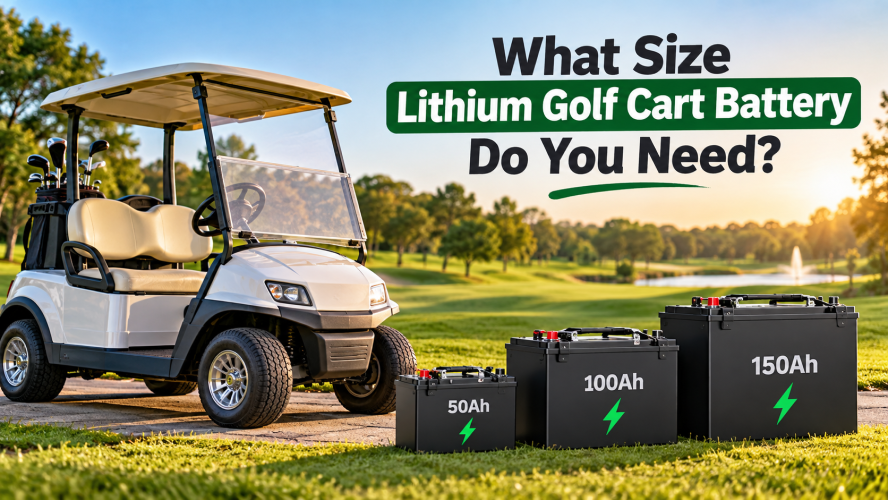
How do you know which lithium golf cart battery size will give you enough range without paying for capacity you do not need?
For most golf carts, 100Ah lithium batteries are a strong starting point for everyday use. A 48V 100Ah battery stores about 4.8 kWh of energy. Larger carts, hilly routes, and longer rides may need 120Ah–200Ah, while lighter use can work with less capacity.
🔋 Understand Ah Capacity First
The Ah rating, or amp-hour capacity, tells you how much electrical charge a battery can store. It is one of the most important numbers when choosing a lithium golf cart battery. However, Ah alone does not tell the whole story. You also need to consider the battery voltage.
For example, a 48V 100Ah battery provides about 4,800 watt-hours, or 4.8 kWh, of nominal energy. A 51.2V 100Ah LiFePO4 battery is slightly higher at about 5.12 kWh. This energy rating helps you compare batteries with different voltages.
⚡ Match Battery Voltage To Your Golf Cart
Before choosing Ah capacity, confirm your golf cart’s voltage. Common golf cart systems include 36V, 48V, and 72V. The replacement battery should be designed for your cart’s electrical system.
A higher Ah rating does not automatically make a battery compatible. Installing the wrong voltage can cause serious electrical problems. Check the cart’s existing battery pack, charger, controller, and manufacturer’s specifications first. 🔧
| Golf Cart Voltage | Common Lithium Size | Nominal Energy |
| 36V | 100Ah | 3.6 kWh |
| 48V | 100Ah | 4.8 kWh |
| 48V | 150Ah | 7.2 kWh |
| 72V | 100Ah | 7.2 kWh |
🏌️ How Much Ah Do You Really Need?
Your ideal battery capacity depends mainly on driving distance, terrain, passenger weight, and cart usage. A cart used for short neighborhood trips has different needs from one used for long recreational rides. Weather and driving habits can also affect energy consumption.
For many standard 48V carts, 100Ah offers a useful balance between range, weight, and price. If you frequently carry several passengers or drive on hills, moving toward 150Ah can provide more energy. 🚗
📏 Estimate Range From Battery Capacity
Battery range is not determined by Ah alone. You need to consider the cart’s energy consumption, which changes with speed, terrain, tires, weight, and acceleration. A simple energy calculation can give you a useful estimate.
Use this basic formula:
Battery Energy = Voltage × Amp-Hours
Then estimate range using the cart’s approximate energy consumption per mile. Real-world range will always vary, so leave some reserve rather than planning to use every last bit of stored energy.
🔋 50Ah Vs. 100Ah Vs. 150Ah
A 50Ah lithium battery can suit very light-duty use. However, it provides half the nominal energy of a comparable 100Ah battery at the same voltage. For regular recreational driving, 100Ah gives you considerably more usable capacity.
A 150Ah battery adds another 50% capacity compared with 100Ah. That extra capacity can be useful for longer trips and demanding terrain. The tradeoff is usually a higher purchase price and potentially more physical space requirements.
| Capacity | 48V Nominal Energy | Typical Use |
| 50Ah | 2.4 kWh | Short, light-duty trips |
| 75Ah | 3.6 kWh | Moderate recreational use |
| 100Ah | 4.8 kWh | Everyday golf cart use |
| 150Ah | 7.2 kWh | Longer trips and heavier loads |
| 200Ah | 9.6 kWh | High-range applications |
🛣️ Consider Your Driving Distance
Think about your normal driving routine before buying a battery. If you typically travel only a few miles around your neighborhood, a huge battery may provide capacity you rarely use. On the other hand, frequent long rides make additional capacity much more valuable.
Make a rough estimate of your weekly mileage. Then consider your longest typical trip, not just your average trip. Choosing based on your longest regular ride helps prevent unexpected low-battery situations.
⛰️ Hills And Heavy Loads Need More Capacity
Flat roads generally place less demand on a golf cart than steep hills. Climbing requires more power from the motor, which can increase energy consumption. The same applies when carrying multiple passengers or heavy equipment.
If your cart regularly faces hills, look beyond Ah capacity. The battery also needs a suitable continuous discharge rating and peak current capability. A battery with plenty of Ah can still perform poorly if its battery management system cannot deliver enough current.
🌡️ Temperature Can Affect Battery Performance
Lithium golf cart batteries usually perform well across normal operating conditions. However, temperature can affect charging and available performance. Extremely cold or hot conditions may reduce efficiency or trigger battery protection systems.
A quality LiFePO4 golf cart battery should include a battery management system, commonly called a BMS. The BMS monitors important conditions such as temperature, voltage, and current. ❄️ This protection is especially important when charging in unusual temperatures.
💰 Bigger Batteries Are Not Always Better
It can be tempting to buy the highest Ah battery available. More capacity can mean longer potential range, but it also usually means spending more money. A larger battery may also require more installation space.
Instead, match capacity to your actual driving habits. Consider these factors:
- Daily driving distance
- Number of passengers
- Terrain and hills
- Cart weight
- Motor and controller
- Available battery compartment space
- Desired charging frequency
- Battery budget
This approach helps you avoid paying for capacity that provides little practical benefit.
🔌 Check The Charger Before Upgrading
A lithium battery conversion may require a lithium-compatible golf cart charger. Your original lead-acid charger may not always have the correct charging profile for a lithium battery. Using an incompatible charger can affect charging performance and battery life.
The charger should match the battery’s voltage and chemistry. For example, a 48V lithium battery needs a charger designed for the appropriate 48V lithium system. Always follow the battery manufacturer’s charging requirements.
🧮 Calculate The Right Battery Size
You can use a simple process to narrow down your choice. First, determine your golf cart voltage. Next, estimate your normal and longest driving distance. Then consider terrain, passenger load, and your preferred charging schedule.
A practical selection process looks like this:
- Identify your cart voltage.
- Estimate your longest regular trip.
- Consider hills and passenger weight.
- Calculate approximate energy needs.
- Add a reasonable capacity reserve.
- Check battery dimensions and connections.
- Confirm charger compatibility.
- Compare lithium battery warranties and BMS specifications.
This gives you a much better starting point than choosing a battery based only on its Ah number.
🛠️ What Else Should You Check?
Ah capacity is important, but it should not be your only buying criterion. A good lithium golf cart battery should have a suitable BMS, discharge rating, cycle life, warranty, and physical dimensions.
Also check the battery’s terminal location and mounting requirements. Some batteries are designed as direct replacements, while others require additional installation hardware. If you are unsure, have a qualified technician confirm compatibility before installation.
📊 Quick Battery Size Guide
For a typical 48V golf cart, the following guide can help you narrow your options. These are general capacity categories rather than guaranteed range figures. Actual range depends heavily on the cart and driving conditions.
| Driving Style | Suggested Capacity | Why |
| Short neighborhood trips | 50–75Ah | Lower energy needs |
| Regular local driving | 100Ah | Balanced capacity |
| Longer recreational rides | 120–150Ah | More range reserve |
| Heavy loads and hills | 150Ah+ | Higher energy demand |
| Extended-distance use | 200Ah | Maximum practical reserve |
❓ People Also Ask About Lithium Golf Cart Batteries
Is 100Ah Enough For A Golf Cart?
For many 48V golf carts, 100Ah is enough for everyday recreational driving. It provides about 4.8 kWh of nominal energy at 48V. Your actual range depends on terrain, speed, weight, motor efficiency, and driving conditions.
How Long Does A 100Ah Battery Last?
A 100Ah lithium battery can provide different driving ranges depending on the golf cart. Battery runtime depends on how much current the motor draws during operation. A properly maintained lithium battery can also provide many years of service.
Is 150Ah Better Than 100Ah?
A 150Ah battery stores more energy than a 100Ah battery at the same voltage. That can provide a larger range reserve for longer trips or heavier use. However, more capacity is not automatically necessary for every golf cart.
What Ah Battery Is Best For 48V?
A 100Ah battery is a common starting point for a 48V golf cart. Drivers with longer routes, hills, or heavier loads may consider 120Ah, 150Ah, or more. Always check the cart and battery manufacturer’s compatibility requirements.
Can I Put A Bigger Ah Battery In My Cart?
You can often increase Ah capacity if the battery fits and the electrical system supports it. However, physical dimensions, BMS output, wiring, charger compatibility, and controller requirements must be checked. Do not assume that every higher-capacity battery is a direct replacement.
✅ Final Takeaway
Choosing the right lithium golf cart battery starts with voltage and Ah capacity, but those are not the only factors. For many 48V golf carts, a 100Ah lithium battery offers a practical balance for everyday use. Longer trips, steep terrain, heavy loads, and frequent driving may justify 150Ah or more.
Before buying, check your cart’s voltage, battery compartment, charger, controller, BMS requirements, and expected driving range. ⚡ The goal is not simply to buy the biggest battery. It is to choose enough usable energy for your driving needs while maintaining compatibility, safety, and value.